
The “Golden Thread” is a name I have given to my list of writers who have written from a true New Covenant perspective. These men and women wrote (or are still writing) about a life lived by the indwelling Spirit of Christ, a life of union with the Triune God and continual, conscious, conversational communion with Him. In all, I have explored the writings of over 70 authors who have written of this New Covenant life of the indwelling life of Christ in us. Enjoy snacking on the stories of these men and women, and then find one of their books and enjoy the feast.
Note: This post is longer than I normally write, but the story is amazing and is worth the time to read. Do you have six minutes for a life-changing story?
D.L. Moody famously stated, “When I was a young man I heard Henry Barley say that the world has yet to see what God can do for a man fully yielded to Him, and I said I wanted to be that man. But I can say today the world has yet to see what God can do with a man fully yielded to Him.” It may well be that William Whiting Borden, a young missionary whose life was cut short as he prepared to go minister among the Chinese Muslims , was that “man fully yielded to Him.”
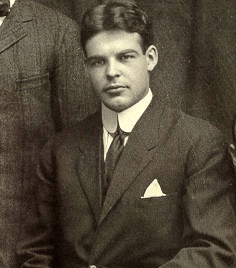
Born in 1887, William Borden entered the world amidst wealth and affluence. His family was quite wealthy, and William attended prestigious private schools in Chicago. Yet this affluent life did not deter the family or William from seeking after the life of God. They attended the Chicago Avenue Church, where Dr. R. A. Torrey was pastor. Under Torrey’s ministry and under the Godly influence of his own mother, William had trusted Christ as Savior and sought daily to follow Him as Lord.
When he graduated from high school his parents gave him a present of a trip around the world, hiring a devout Christian young man to travel with him as his companion and guardian. While on this trip William met a number of Christian missionaries who made a deep impression upon him. He wrote his mother, “When I look ahead a few years, it seems as though the only thing to do is prepare for the foreign field…”
William quickly became a prominent student at Yale as he excelled in the classroom, on the football field, and in friendship. He invested in ministry and service to his college and to the town of New Haven. During William’s freshman year his father died. He, along with his brother, were given access to the family fortune, something William determined to use for the Kingdom of God. Sometimes he would quietly write out a check for a large amount and entirely fund various ministry organizations with which he was involved. But at other times he would spend hours praying with friends for needed funds, feeling like it wouldn’t be honoring to God for him to simply support all Christ’s work apart from prayer and faith.
Also, during his freshmen year William was approached about starting a city mission as a ministry to the downtrodden, and that would provide fellow classmates with a ministry outside of Yale. He was more than eager to be of assistance in this mission, both providing the finances (equivalent to half a million dollars in today’s currency) and administrative leadership. Yale Hope Mission, as it came to be known, annually served over seventeen thousand meals and provided over eight thousand nightly beds, with gospel messages preached daily to all.
William also began meeting with friends for morning prayer and Bible study. At the same time, William eagerly sought ways to motivate other students to join Bible study groups. By the end of his first year 150 were meeting together in groups. By his fourth year at the university there were 1,000 of the 1,300 Yale students attending these Bible studies.
After Yale, he attended Princeton Seminary. While in seminary, Borden was not so preoccupied with his studies that he ceased to be of service. He served as a director for the National Bible Institute in New York City, which focused on equipping men and women with Biblical training and practical ministry skills. Borden also served as a trustee of Moody Bible Institute.

The foreign mission field was William’s aim, and to that end he was ordained into the gospel ministry at Moody Church in 1912. Before leaving, Borden spent that fall traveling to numerous colleges to speak to students about foreign missions. His zeal and dedication for the work of the Lord, along with being called by many the “millionaire missionary,” drew many to his meetings. He urged students to prayerfully consider what part they might play in expanding the kingdom of Christ. His tour of thirty-four schools across multiple states in seventy-six days was an amazing and inspirational feat.
On December 17, 1912, William Borden said goodbye to friends and family and boarded a ship at New York Harbor. His travels took him to Cairo, where he was to spend a year in Arabic and Islamic studies. He rented a modest room from a Syrian family to be better immersed within the culture.
William had not been in Cairo two weeks before he organized students of the theological seminary to begin a house-to-house canvass with Christian literature for the whole city of eight hundred thousand people. After just three months of study and evangelism, something happened to William that shocked the world. The passionate young missionary contracted spinal meningitis. Within a month William Borden was dead.
The news of the young millionaire’s death was flashed by cable around the world. William’s death became international headlines. Memorial services were held in Princeton, at Yale, and at Moody Church in Chicago. Later, it was learned that memorial services were also held in Europe, China, Japan, Egypt and Africa, all places William had influenced in his short life. His passion for Jesus and missions, and willingness to risk everything inspired countless believers to volunteer for missionary service and to dedicate themselves wholeheartedly to the cause of Christ.
He was buried in Cairo as countless tributes poured in from around the world. One such tribute stated the thoughts of many: “William Borden has lived two lives in one; for he has done more in twenty-five years than many men accomplish in fifty.” Another missionary wrote about Borden: “I have absolutely no feeling of a life cut short. A life abandoned to Christ cannot be cut short. ‘Cut short’ means not complete, interrupted, and we know that our Master does no half-way jobs…”
In his Bible were found three powerful messages to himself, written at different times in his life. While he was in school, having made his decision to forsake a comfortable life of wealth and ease in the U. S., he had written, “With no reserve and no delay, with all my heart I come.” After graduating from Yale, with many offers of important positions coming to him, he wrote, “No retreat.” And below these two phrases, written shortly before he died, were the words, “No regrets.” Indeed, William Borden lived a life of no reserve, no delay, no retreat, and no regrets.
The concluding stanza of Isaac Watts’ “When I Survey the Wondrous Cross,” sung as the final hymn during Borden’s ordination, aptly summarizes this young man’s life and heart, who forsook the riches of this world for the riches of Christ:
Were the whole realm of nature mine,
That were a present far too small;
Love so amazing, so divine,
Demands my soul, my life, my all.
Content compiled from Institute in Basic Life Principles, Ligonier Ministries, and Spirit of Grace Ministries websites, as well as from the book, “Borden of Yale ’09” by Helen Taylor.
 One Pursuit
“For though I preach the gospel, I have nothing to glory of: for necessity is laid upon me; yea, woe is unto me, if I preach not the gospel!” To settle for anything less is compromise.
Blessings brother
BT
LikeLike
Pingback: The Hymnary – O Love That Will Not Let Me Go – One Pursuit